Introduction
If you're reading these lines, it means you've just treated yourself to a tool designed to make subtitle editing simple, pleasant, and visual. Rougegorge Subtitles was created for anyone who needs a lightweight solution — without getting lost in complicated menus or overpriced software.
Rougegorge Subtitles is the result of a personal project. My name is Robin Erard, a filmmaker and colorist based in La Chaux-de-Fonds, Switzerland, running the studio Rougegorge Postproduction. After more than 15 years working on films and juggling subtitles, I realized there was no software that was both simple, accessible, and reliable enough to handle this workflow.
Of course, there were options like the remarkable Annotation Edit, but since its creator's passing, the software has stopped evolving and remains ill-suited for occasional users. So I decided to dive in — armed with a bit of stubbornness, a lot of passion… and, I'll admit, the help of an AI.
My goal? To offer a practical tool for directors, producers, distributors, or anyone who wants to manage their subtitles without the headache.
Rougegorge Subtitles is constantly evolving. Your feedback is invaluable in shaping future versions, so don't hesitate to share your ideas and suggestions.
Happy subtitling!
Robin Erard
Basics
SDH & Standard
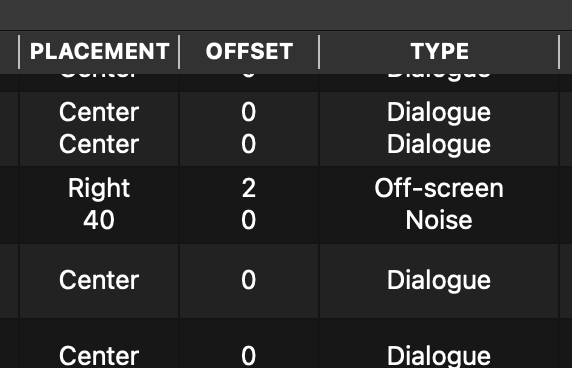
Rougegorge lets you edit subtitles in standard mode, but also in SDH (Subtitles for the Deaf and Hard of Hearing) mode. Each line within a subtitle block can be positioned and modified independently, enabling high-quality SDH subtitles to make your projects more inclusive.
Timecodes
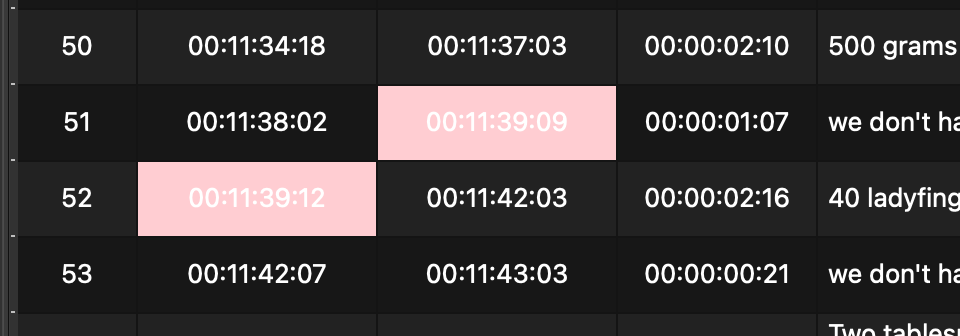
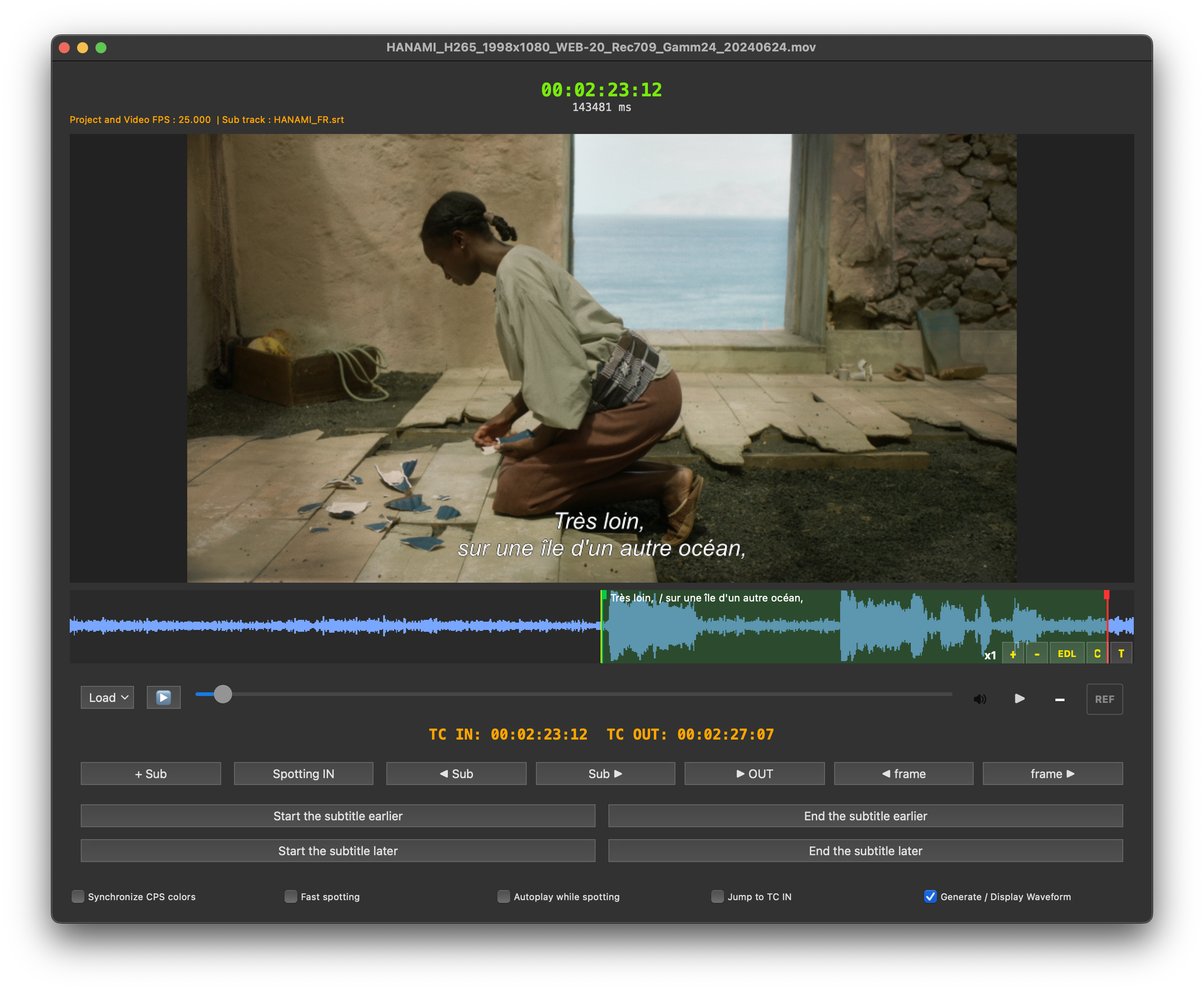
By convention, TC IN is inclusive (the subtitle appears starting from this frame) and TC OUT is exclusive (the subtitle disappears just before this frame).
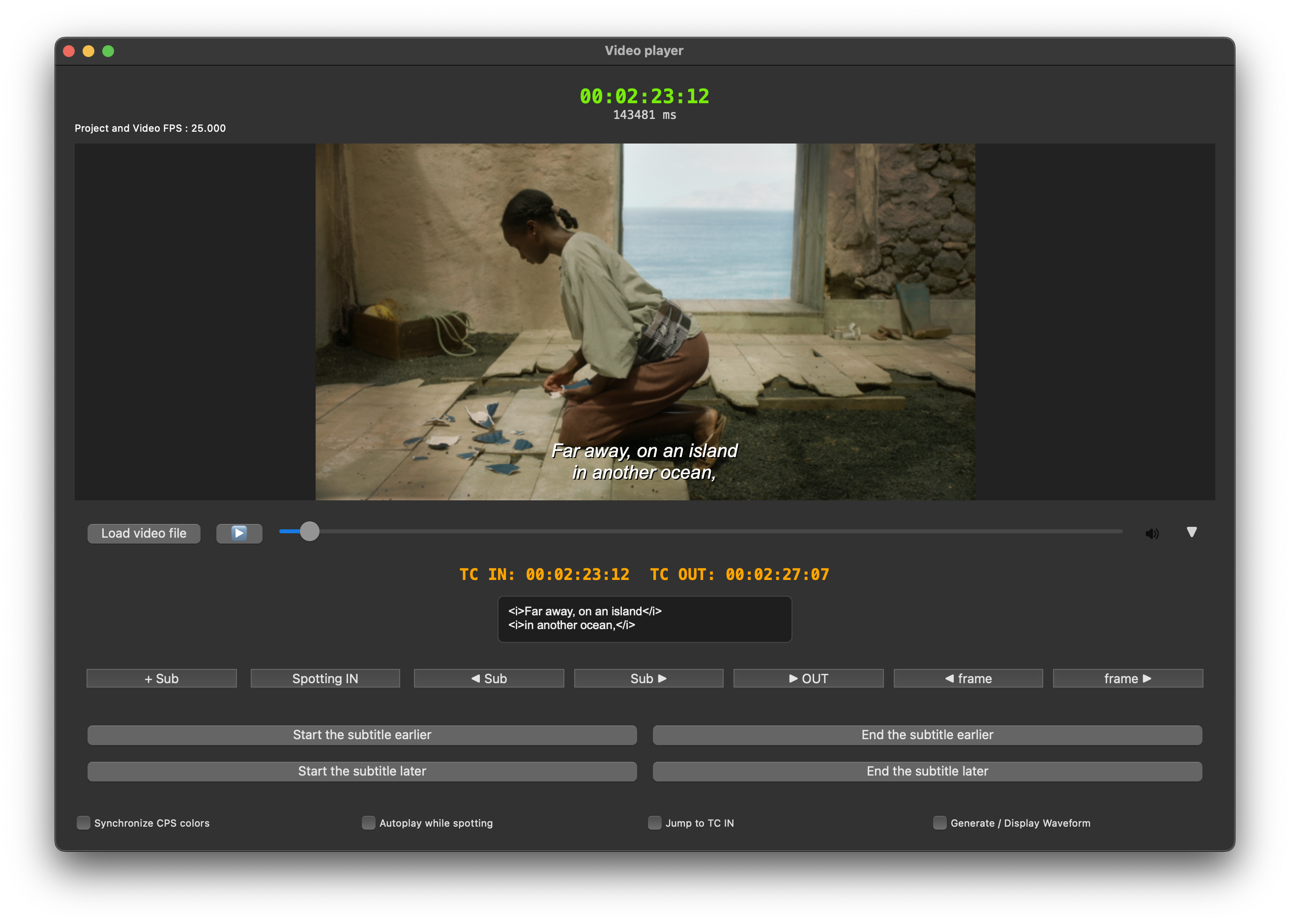
In this example: the subtitle is visible at 00:02:23:12, but no longer visible at 00:02:27:07. This is a standardised convention and Rougegorge Subtitles follows it.
Context Menu
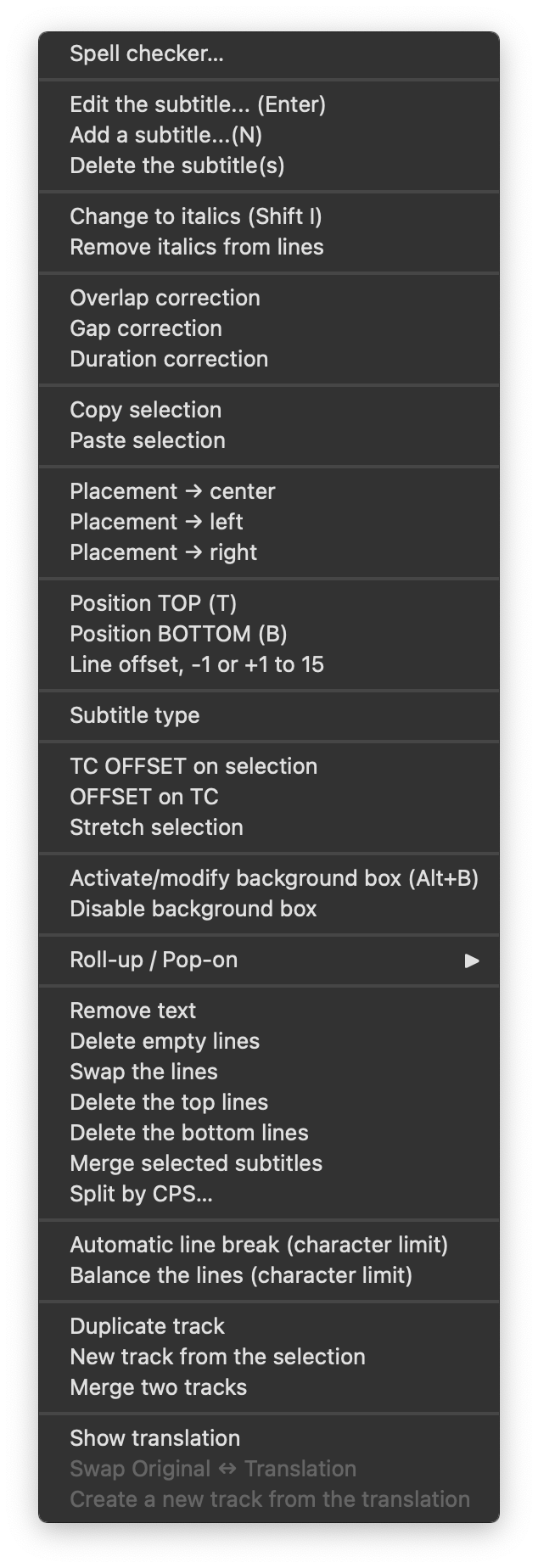
Many users don't realise that a context menu exists, accessible by right-clicking on the table. Don't miss out on all the functions it offers — they are detailed in the "Context Menu" chapter.
Languages
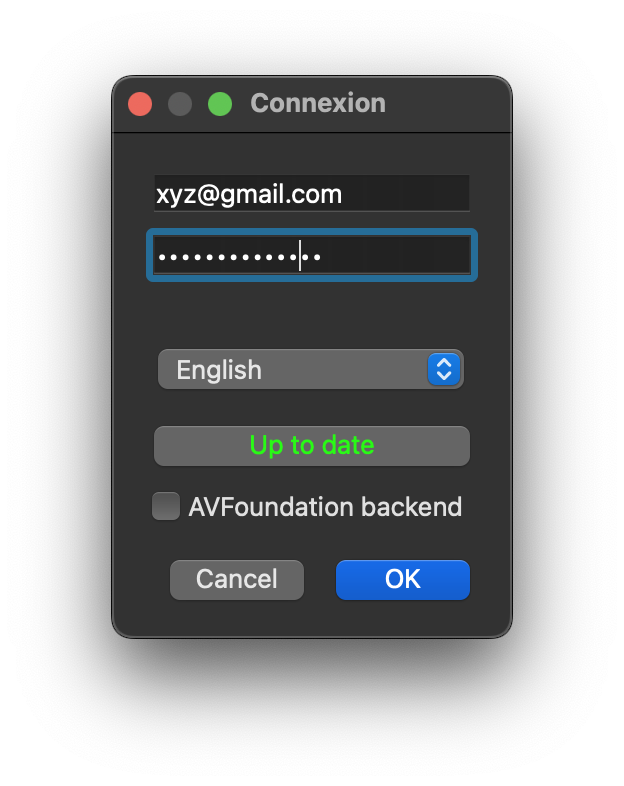
Rougegorge is available in French and English. Select the language at application startup. Updates are indicated in the login window.
Text Encoding / UTF-8
Rougegorge Subtitles only supports UTF-8 encoding on import. All exports are generated in UTF-8. SRT files not in UTF-8 are automatically converted to ensure correct import.
Synchronisation
Both windows (main window and video player) are linked. Any action in one window triggers a reaction in the other. Changes are instantly reflected. When the player is open, subtitles scroll through the table in sync with the film.
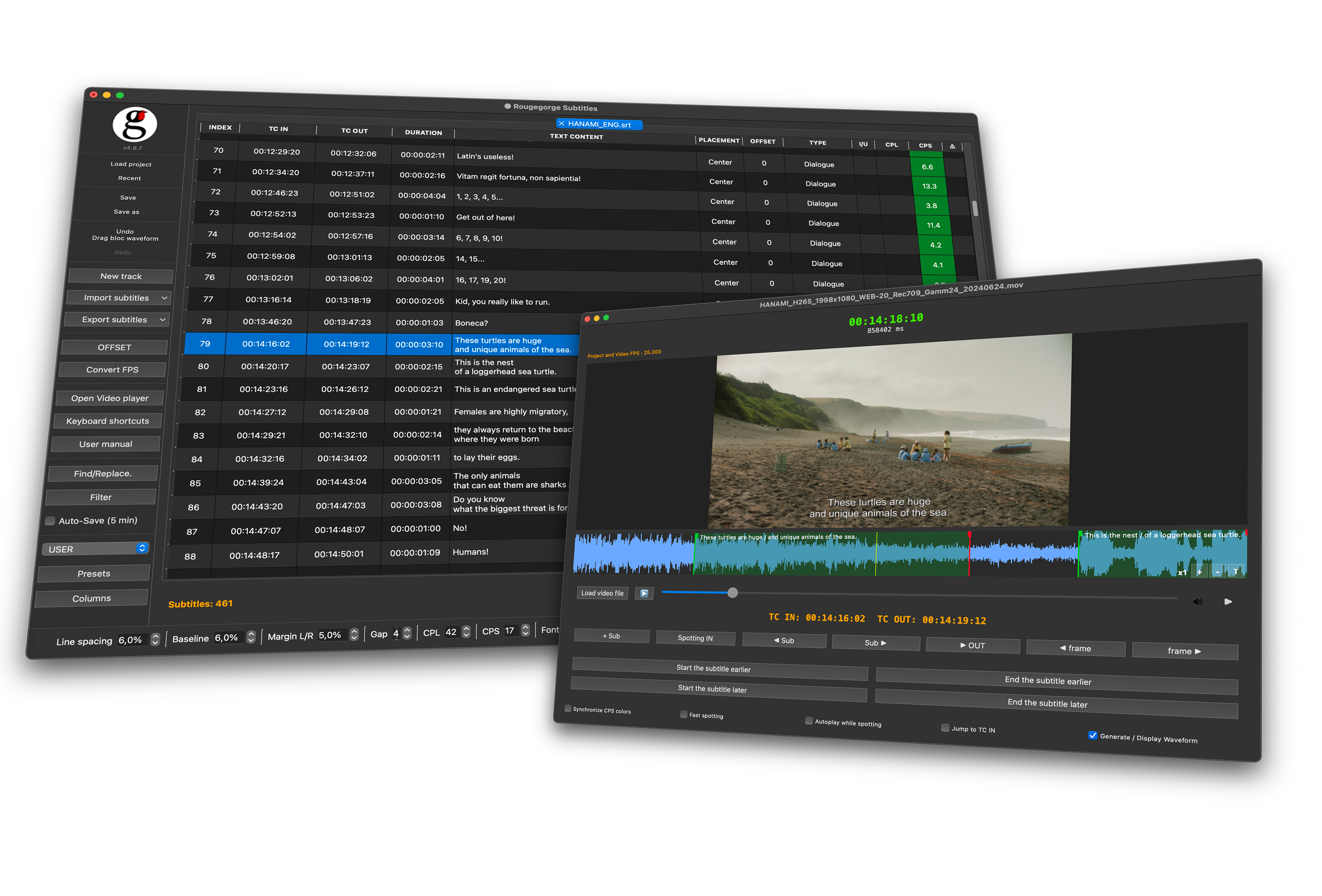
Main Window
The Table
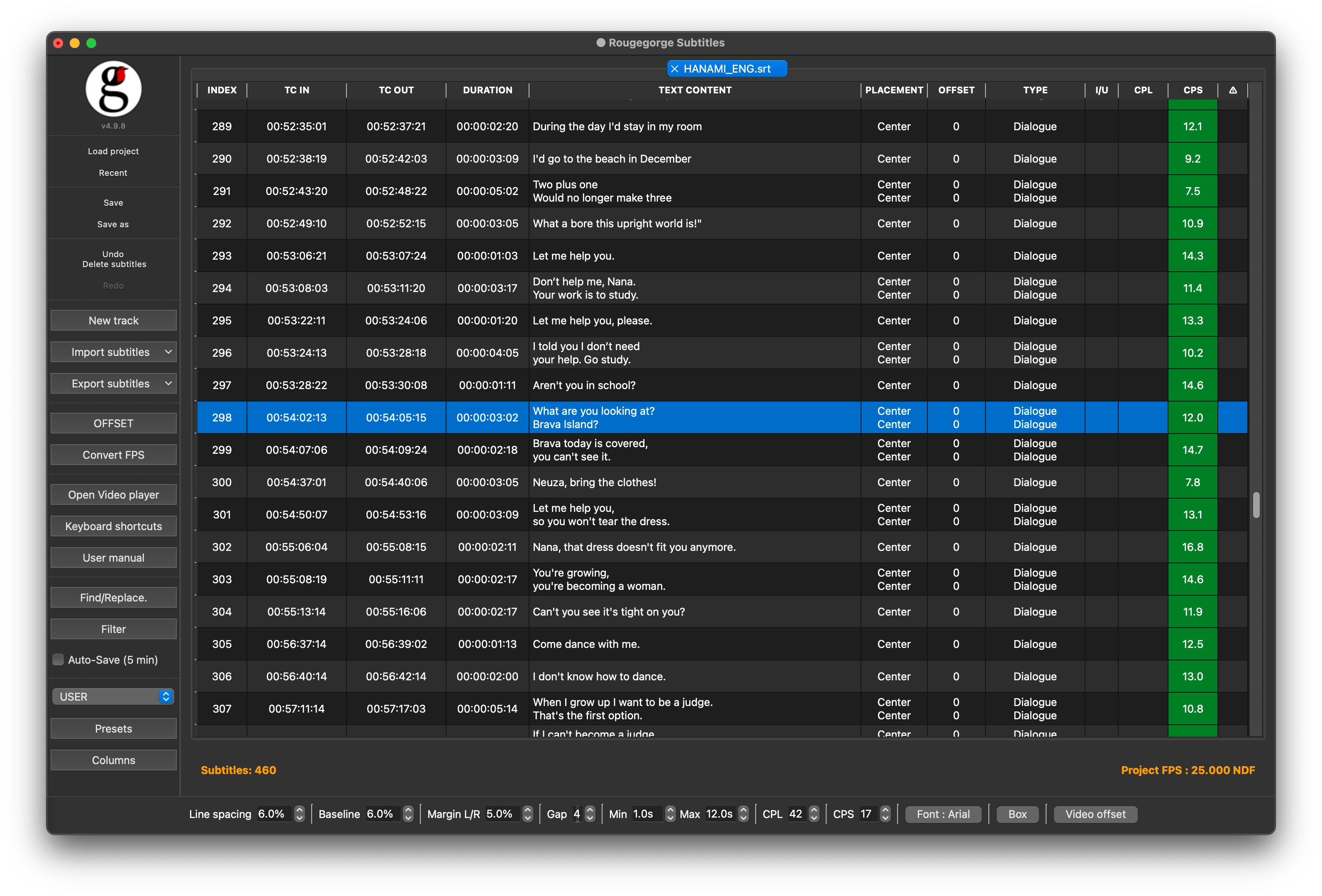
The table lists all subtitles in your project. It is made up of 12 columns displaying the settings for each subtitle block.
<i></i> indicate italics. Bottom Bar

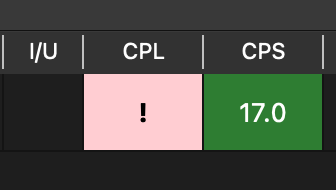
Manages display options and CPS/CPL target values.
B.ex GAP = 4
E.g. with Min = 1s and Max = 12s.


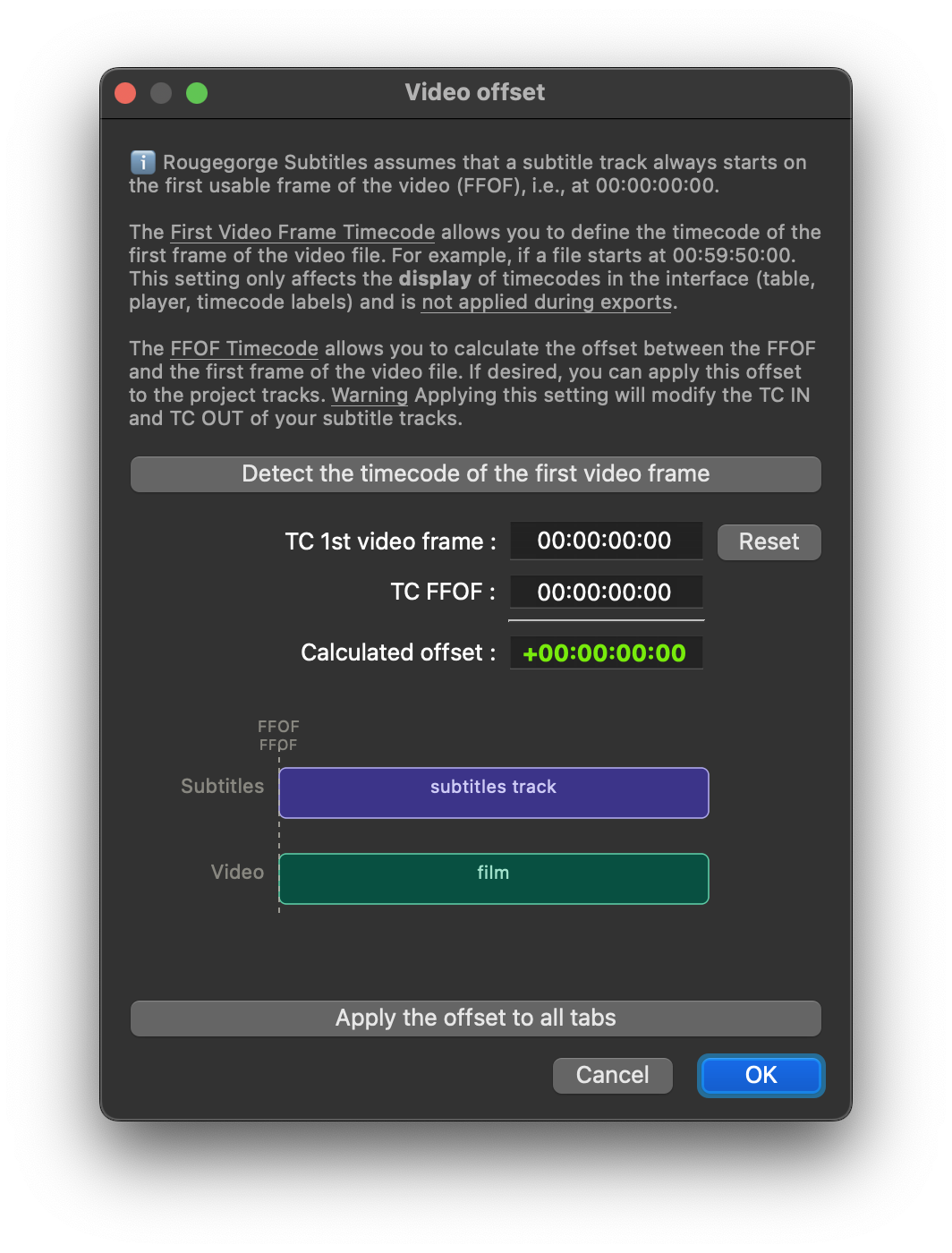
Note: Rougegorge always treats the beginning of the video file as timecode 00:00:00:00 — it has no concept of leader or pre-roll before the film.
If your video file contains embedded timecode (e.g. starting at 00:59:50:00), or if you want to simulate the presence of a leader, the Video Offset window lets you do two different things:
Display offset (virtual — never applied to exports) Enter or detect the file's embedded TC by pressing Detect…, then click OK. The TC IN and TC OUT columns will display timecodes offset by this value, so what you see matches the real-world timecode of the film — but the subtitle file itself is unchanged. Exports always use the raw, unshifted timecodes. The button turns orange when an offset is active in the project.
Apply offset to all tabs (permanent) Enter a FFOF timecode and click Apply the offset to all tabs. This permanently shifts all TC IN and TC OUT values across every tab by the calculated offset. Unlike the display offset, this is a real edit — the subtitle data is modified.
Side Bar

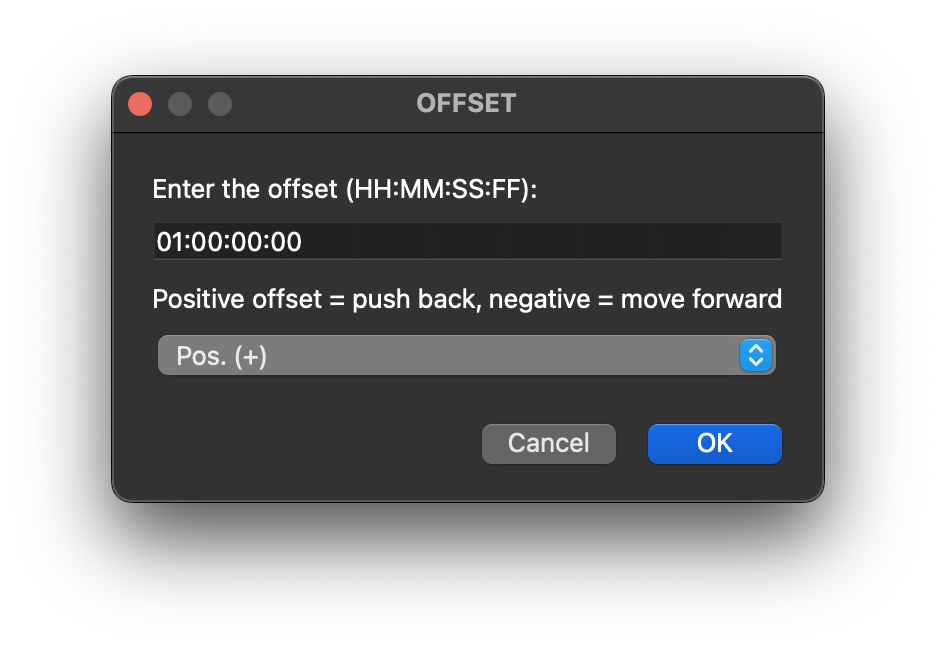
Exports
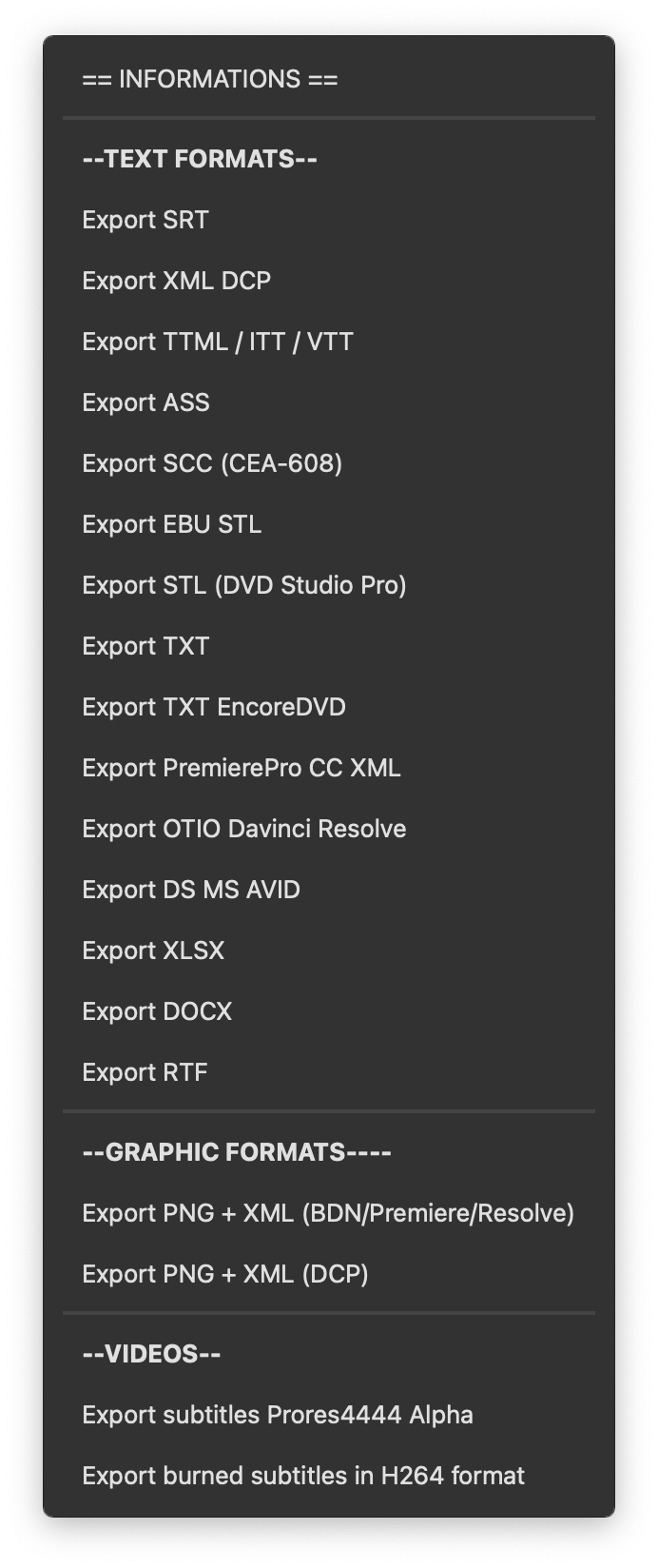
Three types of export are available:
Find
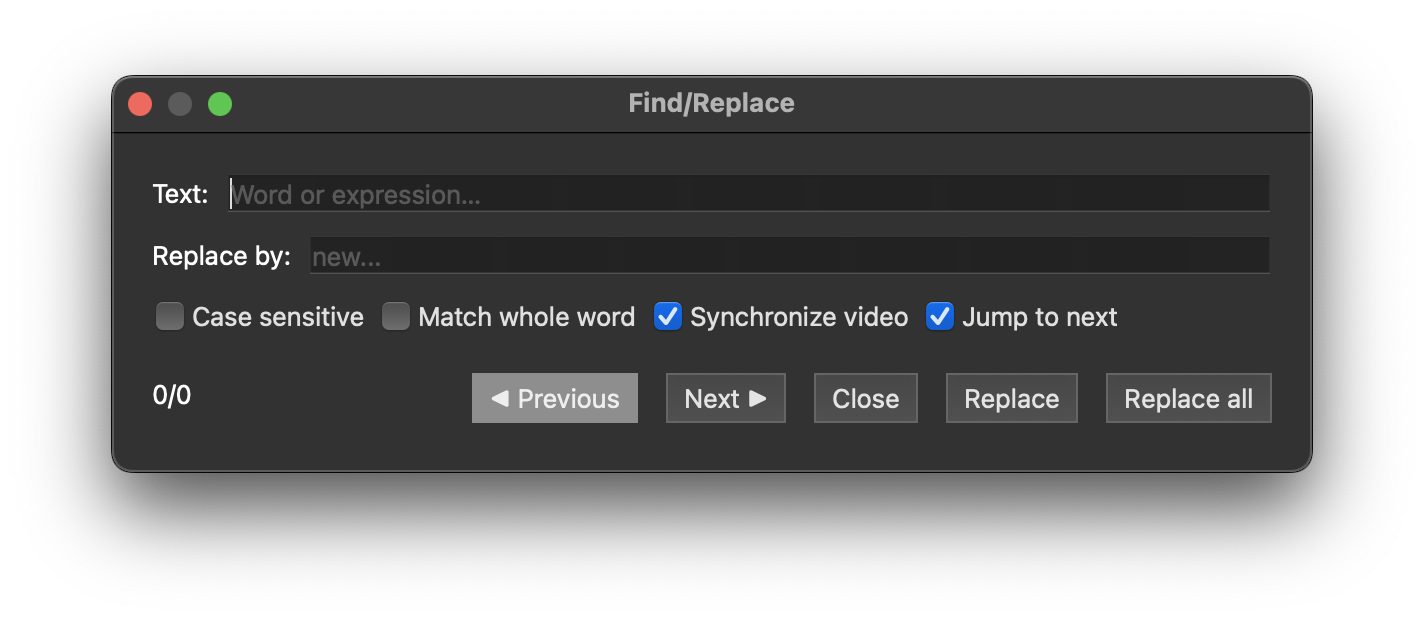
Searches for text in the active subtitle tab. The "Synchronize video" option keeps the video player in sync with each found occurrence.
Filter
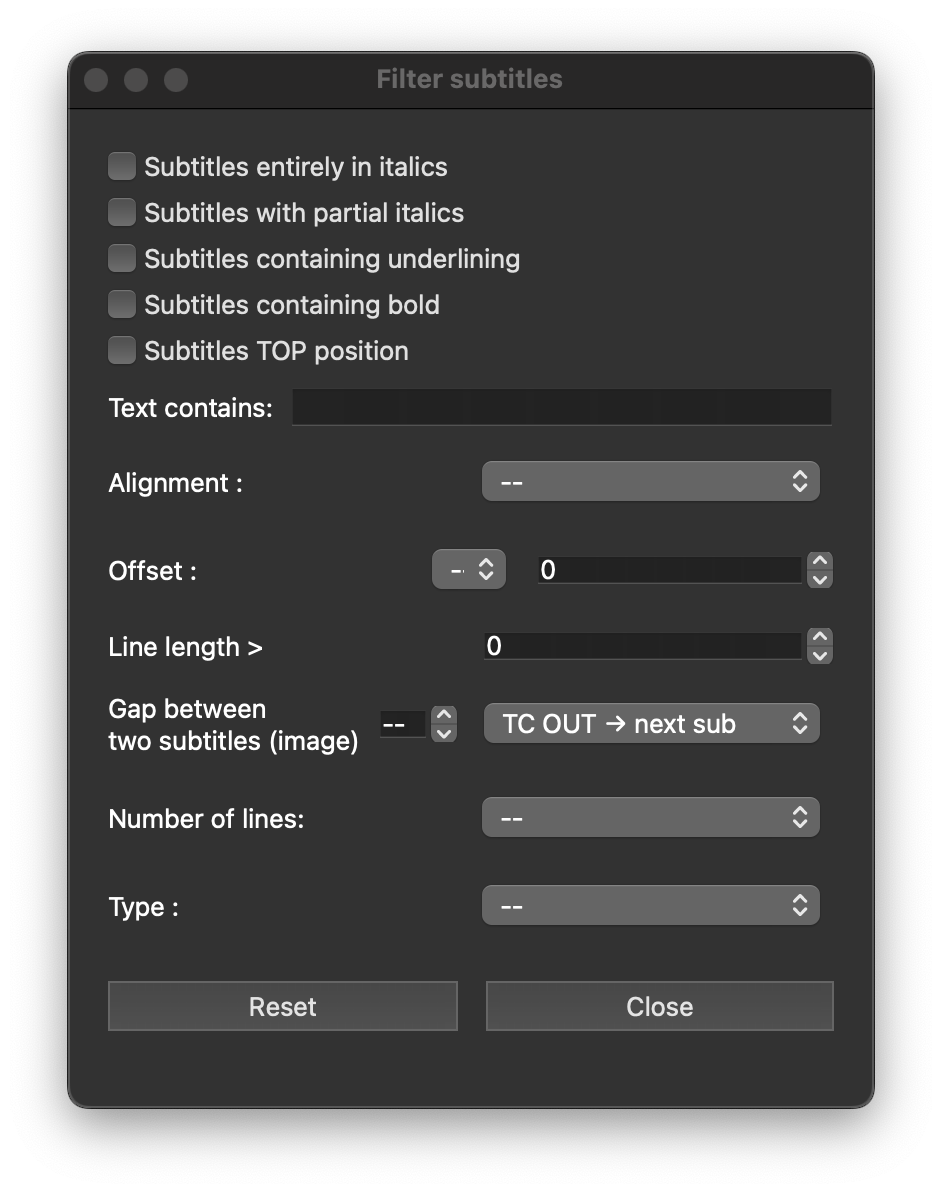
Filters subtitles by one or more criteria (italics, alignment, offset, length, type, gap). The filter remains active as long as the dialog stays open. Subtitles keep their index. You can edit subtitles while the filter is active to batch-modify them.
Context Menu
Right-click on a subtitle or a selection → context menu. The options apply to the active tab and/or the selected subtitles.

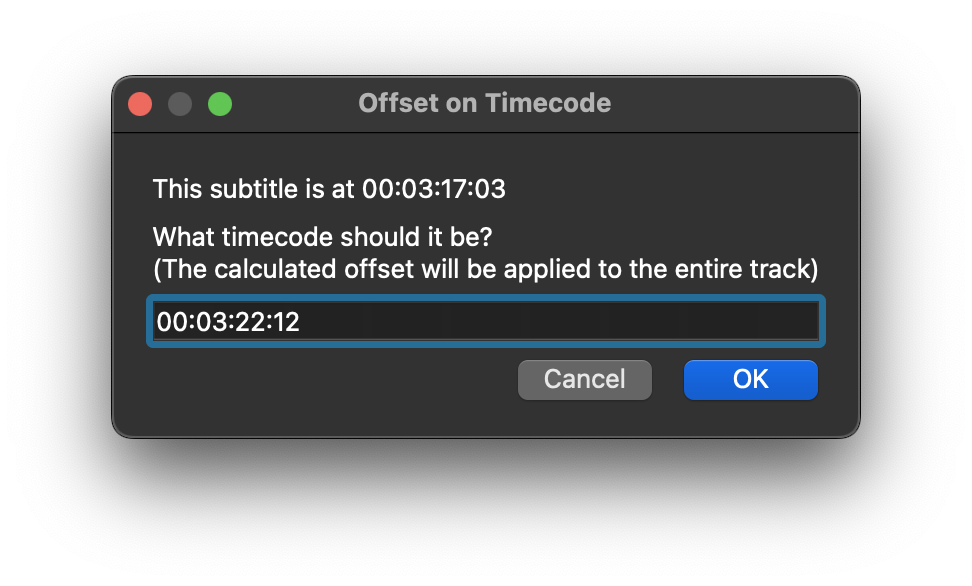
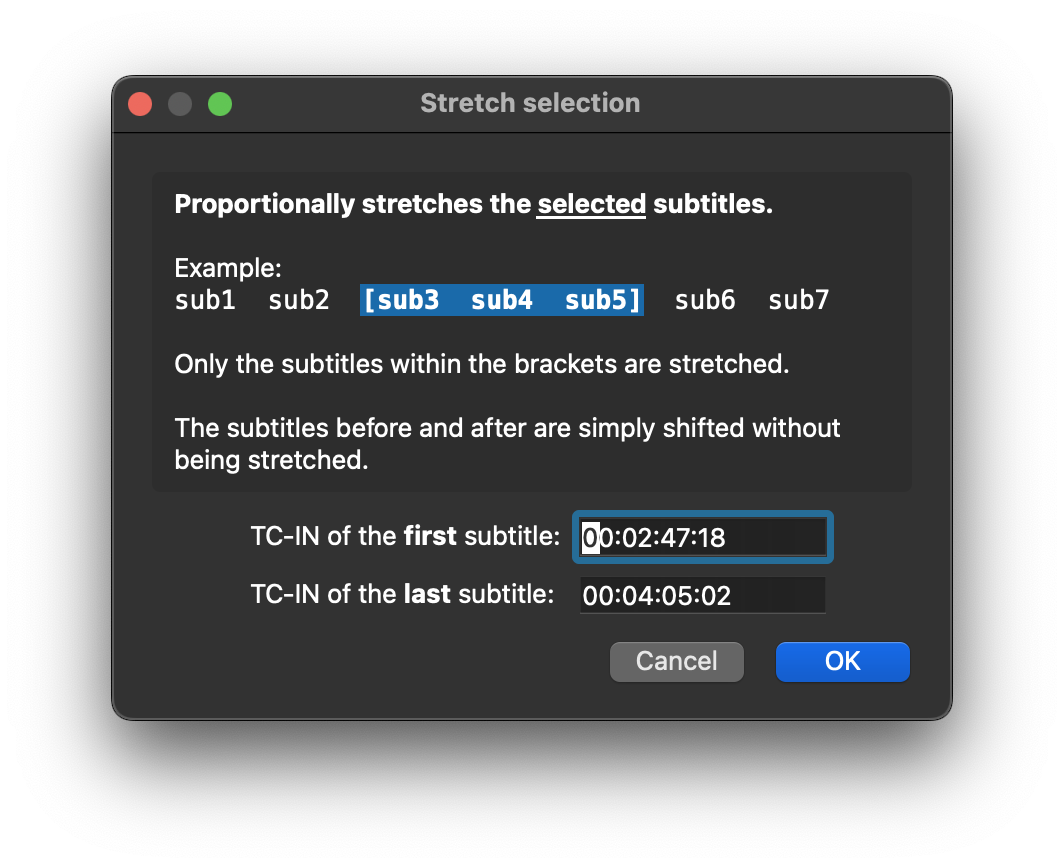

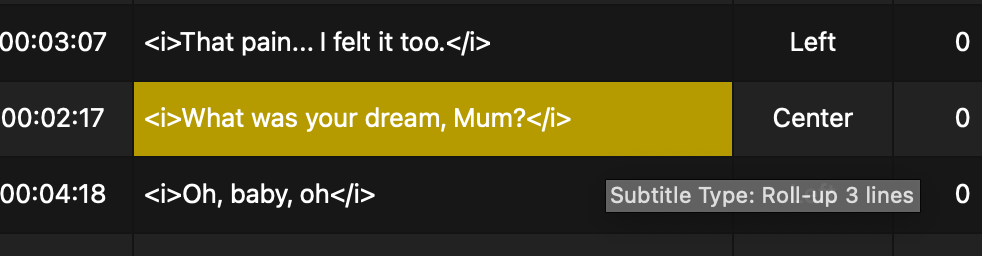


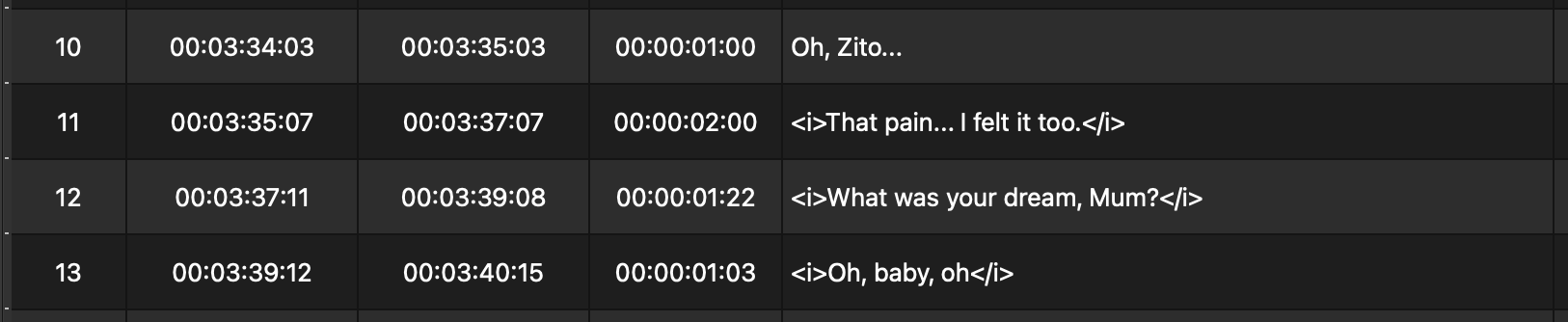
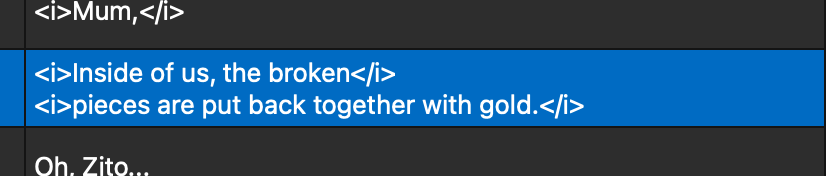
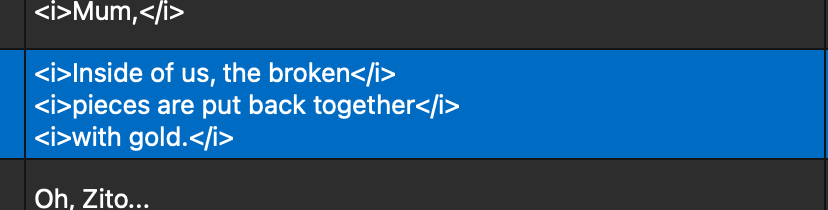
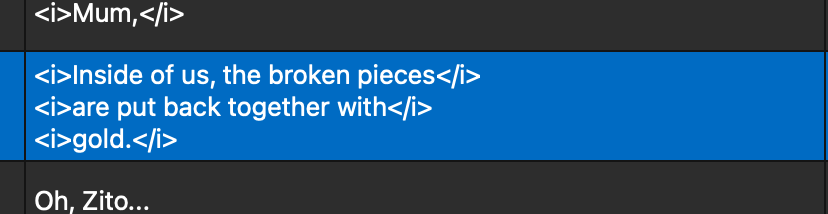
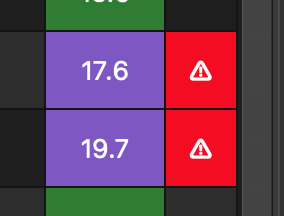
The TC IN of the first subtitle resulting from the division will be equivalent to the TC IN of the subtitle block before the division. Then, the distribution of each new line will be done according to the CPS and GAP values. For example, here, a division into 4 unique lines with a GAP of 4 frames and a CPS of 17.

Subtitle Editor
Opening the editing window
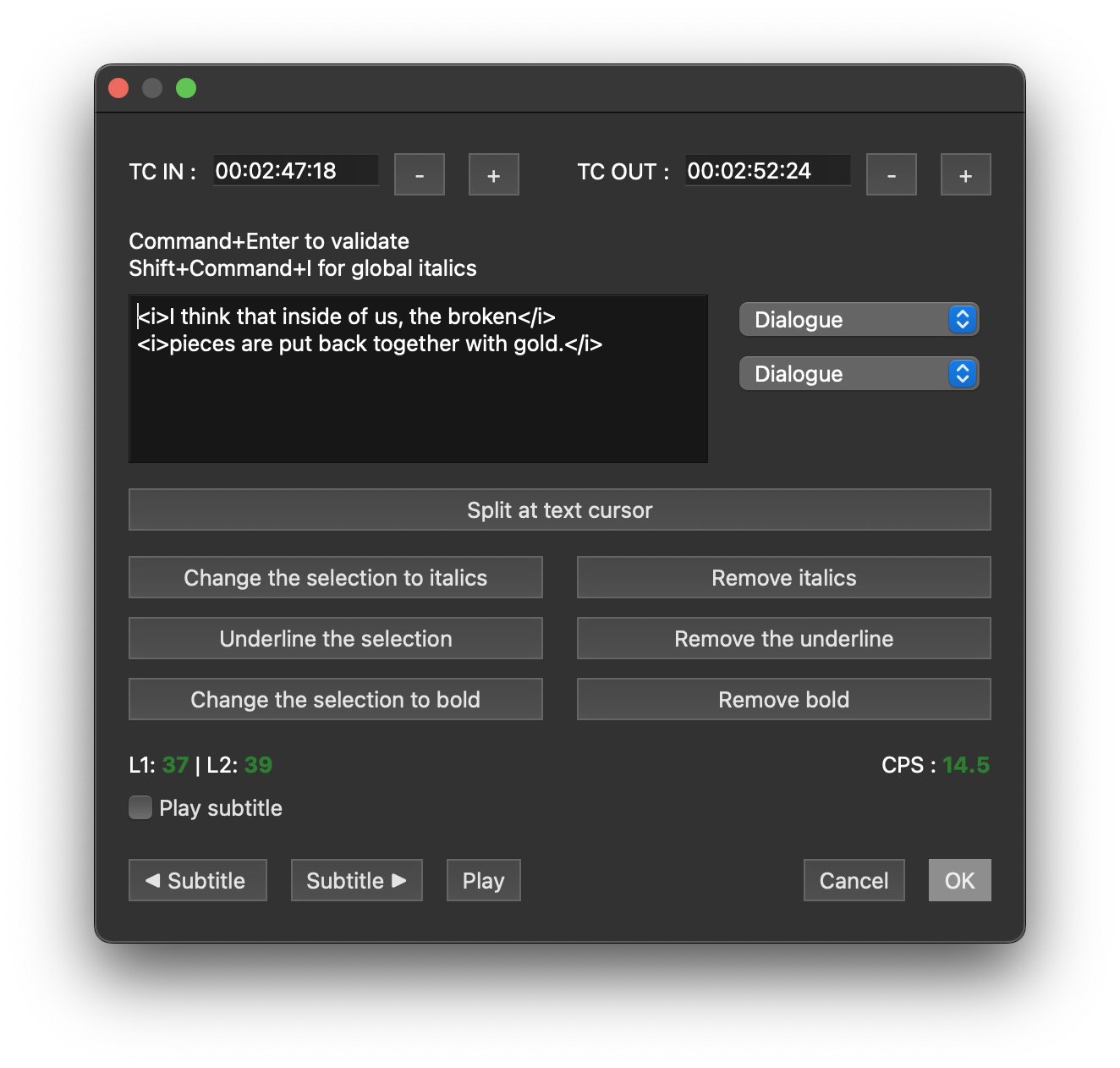
Double-click on a subtitle or press ENTER. Use TAB to navigate between the text field and TC IN / TC OUT fields.
Functions
<i>, <u>, <b>.Shortcuts in the editing window
Adding & Spotting
Rougegorge Subtitles offers several ways to add a subtitle — from the main window or from the video player.
From the Main Window
From the Video Player

Spotting Options
Keyboard Shortcuts
File
Table
Video Player
Formatting — Player and Table
Subtitle Editor
Video Player
Basics
The video player is permanently synchronised with the subtitle table of the active tab. The active subtitle appears highlighted in blue in the table. It remains blue until the TC IN of the next subtitle or the TC OUT of the previous subtitle is reached.

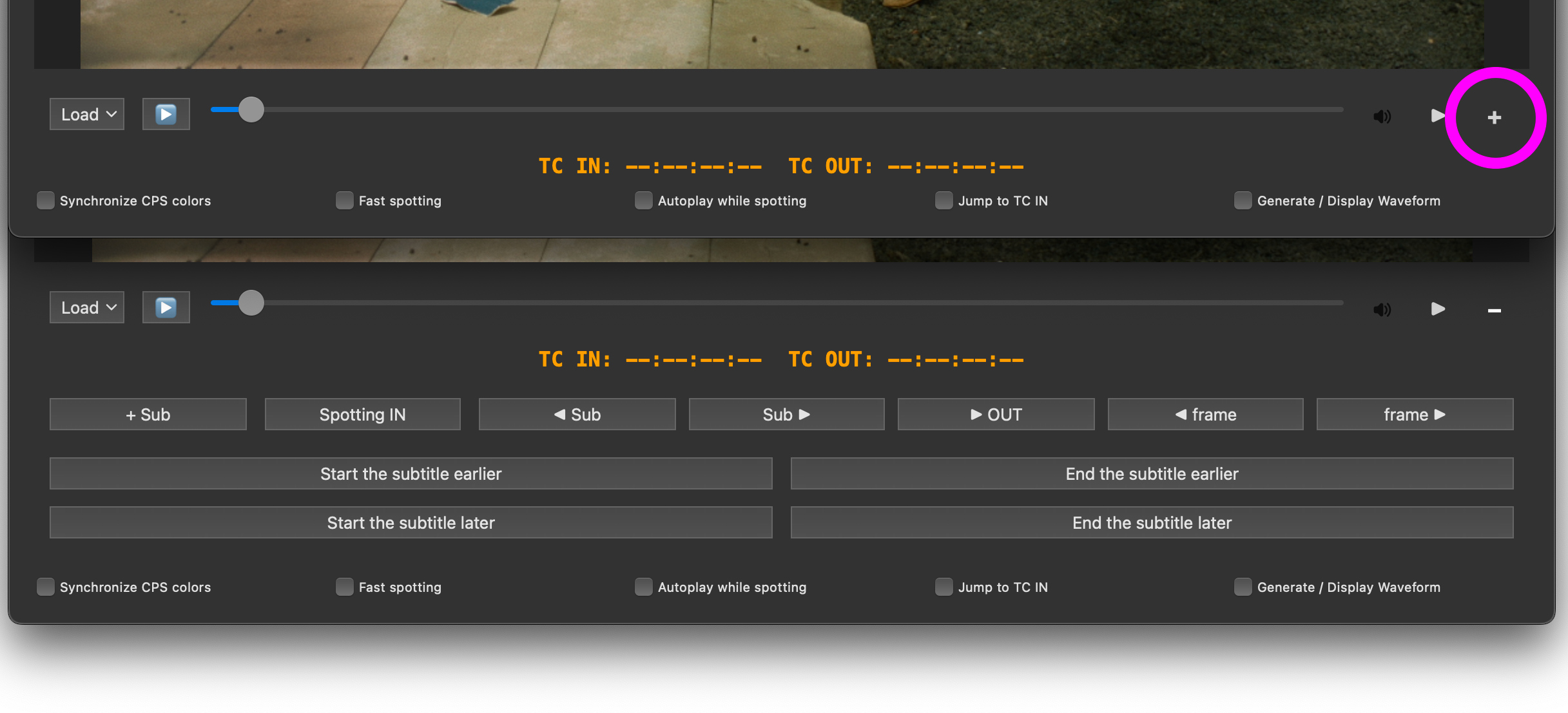
The controls can be shown or hidden by pressing the + or - button to the right of the playback bar.
WYSIWYG?
The video player is WYSIWYG (What You See Is What You Get), meaning the subtitle display and positioning matches the exports — provided those exports support the relevant formatting attributes. Here is the list of exports whose output matches the player display (with some nuances).
| Format | H. Pos. | V. Pos. | Font & Style | SDH Colours | Box |
|---|---|---|---|---|---|
| XML DCP | YES | YES | Arial default | YES | NO |
| PNG / DCP PNG | YES | YES | YES | YES | YES |
| ProRes 4444 | YES | YES | YES | YES | YES |
| H264 | YES | YES | Font only | YES | Square |
| ASS | YES | YES | Font only | YES | Square |
| OTIO Resolve | YES | YES | YES | YES | NO |
| TTML Resolve | YES | YES | Arial default | YES | NO |
Player Interface

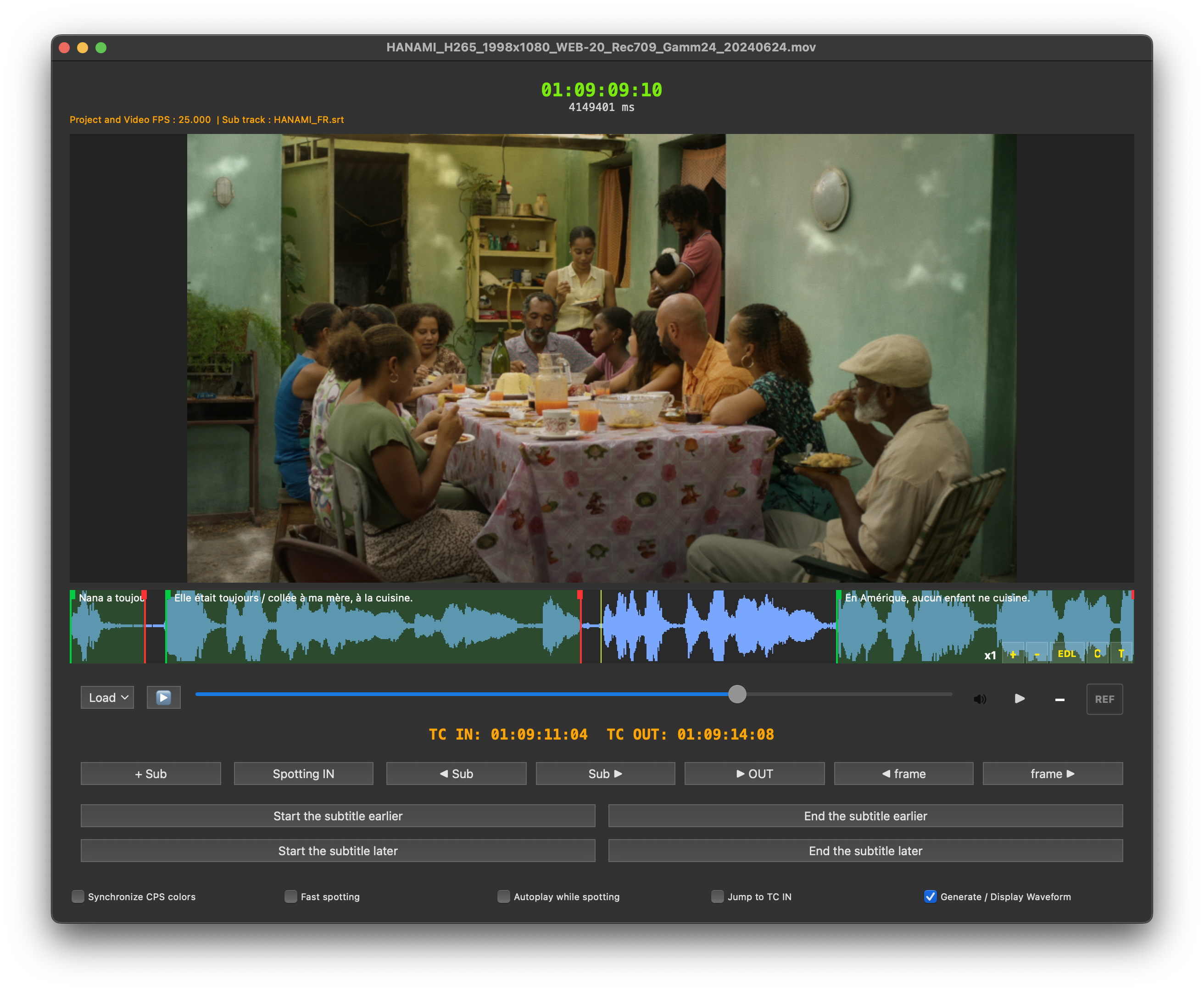
Waveform
Enable GENERATE/DISPLAY WAVEFORM to display the audio waveform. Subtitle blocks are overlaid with transparency, coloured by CPS. Blocks can be adjusted with the mouse or keyboard shortcuts. The generated waveform is saved to a sidecar file (*.wavecache) next to the project file, so it does not need to be regenerated each time the project is opened.
To facilitate spotting, the waveform automatically adjusts its display amplitude during playback to reveal oscillations of quieter sounds.
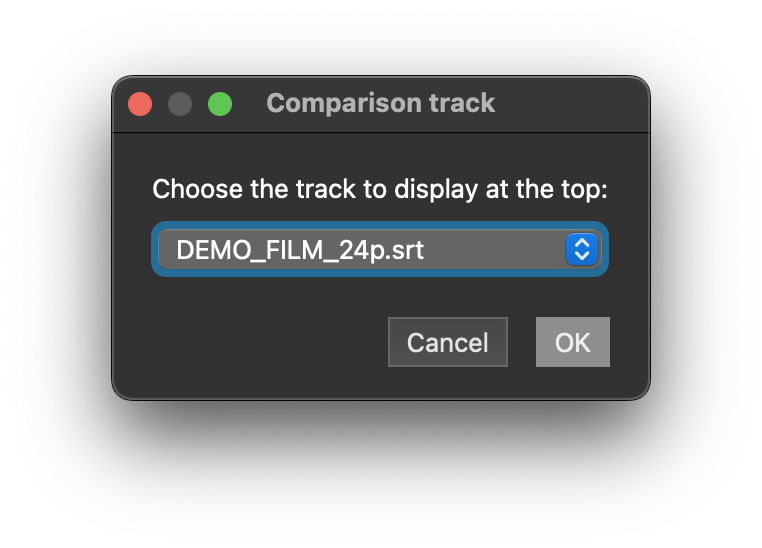
Load an EDL file to visualize its events in the waveform as colored blocks (alternating yellow and magenta). Use this to spot on-screen text elements — such as chapter titles or lower thirds — and check whether any subtitles conflict with them.
You can navigate between EDL events with SHIFT + N (next) and SHIFT + P (previous).
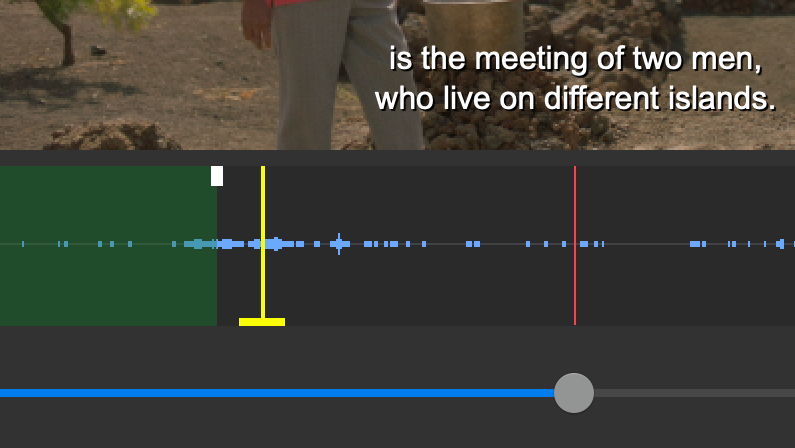
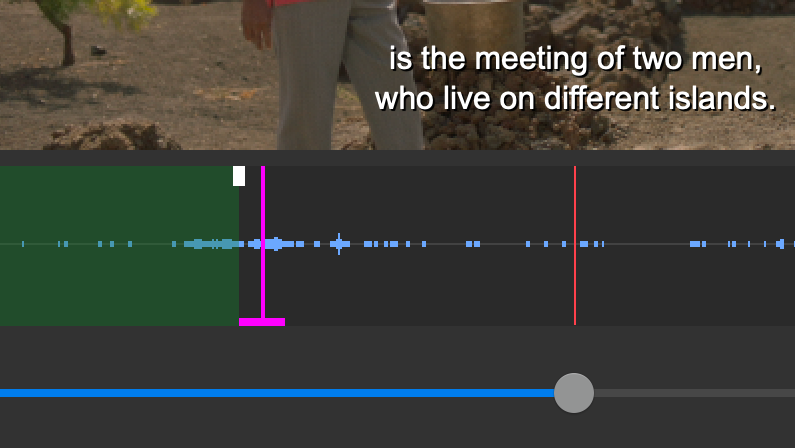
SHIFT CDetects video cuts internally using FFMPEG, or lets you load a cut EDL. Cuts appear in yellow, or in magenta if a subtitle overlaps or is closer than the GAP value.
Navigate between scene cuts flagged as problematic — i.e. overlapping or within the minimum gap of a subtitle. Use SHIFT + OPTION + N to jump to the next conflict, and SHIFT + OPTION + P to go back to the previous one.
Keyboard Shortcuts (Player)
Export Formats
Text Formats
Export to DaVinci Resolve
Rougegorge Subtitles makes it easy to export your subtitles to DaVinci Resolve. Several formats are available — here is a summary of their respective limitations.
| Format | Font & Style | Position | Outline | Shadow | Partial Italic | Box |
|---|---|---|---|---|---|---|
| OTIO | YES | YES | Inner border | NO | YES | NO |
| TTML | Arial default | YES | Value 1 | NO | NO | NO |
| PNG XML | YES | YES | YES | YES | YES | YES |
| PRORES4444 | YES | YES | YES | YES | YES | YES |

Rougegorge Subtitles
User Manual · Version 5.0.5